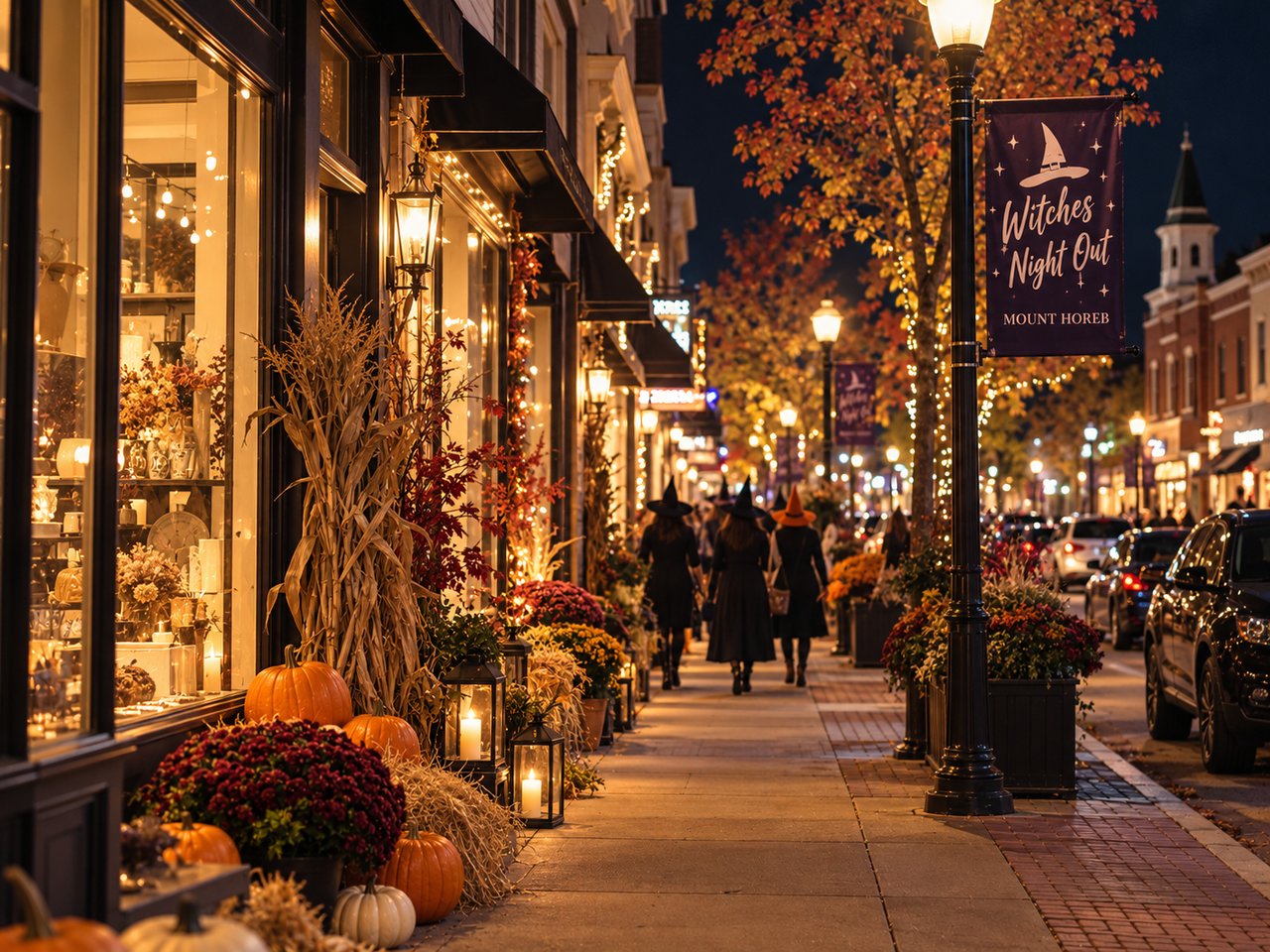
On September 26, ten blocks of Monroe Street will host a festival with a bouncy castle, a book sale, live music at Monroe Commons by Trader Joe's, and Henry the Lion wandering the crowd in his Henry Vilas Zoo costume. By Sunday morning, the festival will be over and the street will return to its regular rhythm.
The festival is one Saturday on Monroe Street's calendar. For people who live in Nakoma, Monroe Street and the surrounding neighborhood are also part of everyday life throughout the year.
What Actually Happens on the 26th
This year marks the 48th Monroe Street Festival, running 10 a.m. to 5 p.m. across the 1600 to 2600 blocks. The Monroe Street Merchants Association organizes it, and the footprint stretches across roughly ten blocks of a corridor that runs over a mile and a half from the UW Arboretum toward Camp Randall Stadium. So even at full festival size, the event covers a fraction of the street Nakoma residents actually use.
The specifics repeat some version of themselves every year: sidewalk sales up and down the block, free outdoor music on two stages, kids' games, a used book sale at the Monroe Street Library that's been running for decades, and food specials rotating through whichever restaurants are participating that cycle. Past years have included a scavenger hunt routed through shops like Mystery to Me and Orange Tree Imports, storewide discounts at Neuhauser Pharmacy, and giveaways timed to first-in-line customers. None of it requires advance planning. You walk down, you find whatever's happening that hour, and you leave when you're done.
The festival offers a lively snapshot of Monroe Street in one afternoon. Nakoma's everyday character is also shaped by routines that continue throughout the year.
The Blocks Nakoma Already Has Memorized
Two blocks from Nakoma sit two restaurants that are part of the neighborhood's regular dining scene. Gates & Brovi mixes Italian and pub fare into one Monroe Street menu, and Badger Tavern has built its identity around the Friday fish fry, a Wisconsin institution.
Inside Nakoma Plaza, Gino's Italian Deli has been making Italian subs to order for long enough that ordering there isn't really a decision anymore, it's a habit. Head the other direction toward Midvale Boulevard and the neighborhood's food geography widens further, with Restaurante El Panzon, Taqueria El Jalapeno, and Santa Maria Grocery covering the Mexican grocery and eatery side of things that Monroe Street itself doesn't. These businesses add to the area's regular food options.
Then there's Old Spring Tavern, which has stood as one of the neighborhood's history markers for long enough that most Nakoma residents can't remember a version of the area without it. It remains part of the area's year-round character.
Here's roughly what changes, and what doesn't, on festival Saturday versus any other Saturday on this stretch of Monroe Street:
| Festival Saturday (Sept 26) | A Regular Saturday | |
|---|---|---|
| Foot traffic | Citywide, plus visitors | Neighborhood-scale |
| What's open | Everything, plus street vendors | Regular hours |
| Music | Two outdoor stages | None scheduled |
| Where to eat | Whatever's running a special | Gates & Brovi, Gino's |
| Parking | Tight, spread beyond the 1600-2600 blocks | Normal |
| Duration | One day, 10 a.m. to 5 p.m. | Every week |
The table shows the difference between a festival Saturday and a regular Saturday in the neighborhood.
Nakoma's Year-Round Calendar
Nakoma also has its own social calendar, separate from Monroe Street's public programming and largely built for residents. The Nakoma League, the neighborhood's longstanding community organization, coordinates events that have been part of the area's rhythm for years, including a Fall Gathering, a Children's Halloween Party, a Twelfth Night Dinner and Theatre, a Spring Egg Hunt at Nakoma Park, a Tulip Time Progressive Dinner through neighborhood homes, and a Fourth of July Picnic and Parade that returns to Nakoma Park every summer.
Layer that alongside what the Crawford-Marlborough-Nakoma Neighborhood Association organizes, including its role helping sponsor Make Music Madison performances that run partly out of Westminster Presbyterian Church on Nakoma Road, and you get a picture of the neighborhood's fall calendar alongside Monroe Street's public events. The Fall Gathering typically lands in the weeks right after the festival, adding another seasonal gathering to the neighborhood's calendar.
Nakoma's events are primarily organized for residents, and some take place inside member homes. This gives the neighborhood calendar a more local scale than Monroe Street's public festival.
What This Says About the Place, Not Just the Day
Nakoma was platted in 1915 with curvilinear streets designed to follow the land's natural contours rather than cut against them, and the private Nakoma Golf Club has anchored the neighborhood since 1921, back when the whole area was conceived as a country club suburb rather than a standard subdivision. That history explains something about why the neighborhood still runs its own internal calendar instead of folding entirely into whatever the broader city has planned. It was built with its own center of gravity from the start, and the tradition of resident-run gatherings is a continuation of that, not a recent addition.
None of this means skip the festival. It's a good day, the kind worth walking down for even if you already know every shop on the block. If you live in Nakoma, the festival is one part of Monroe Street's calendar, alongside the neighborhood routines that continue through the year: the Friday fish fry, the sub shop and the Fall Gathering.
That's worth knowing if you're the one already living here, and it's worth knowing if you're someone considering a move into the neighborhood and looking for a sense of everyday life beyond one Saturday in September. Nakoma has a quieter, year-round rhythm alongside the festival.
If you're curious what else makes Nakoma work the way it does, or you're weighing a move into the neighborhood, Husky Homes | Compass knows this stretch of Madison block by block. Reach out anytime for a local's perspective on the neighborhood and its everyday character.