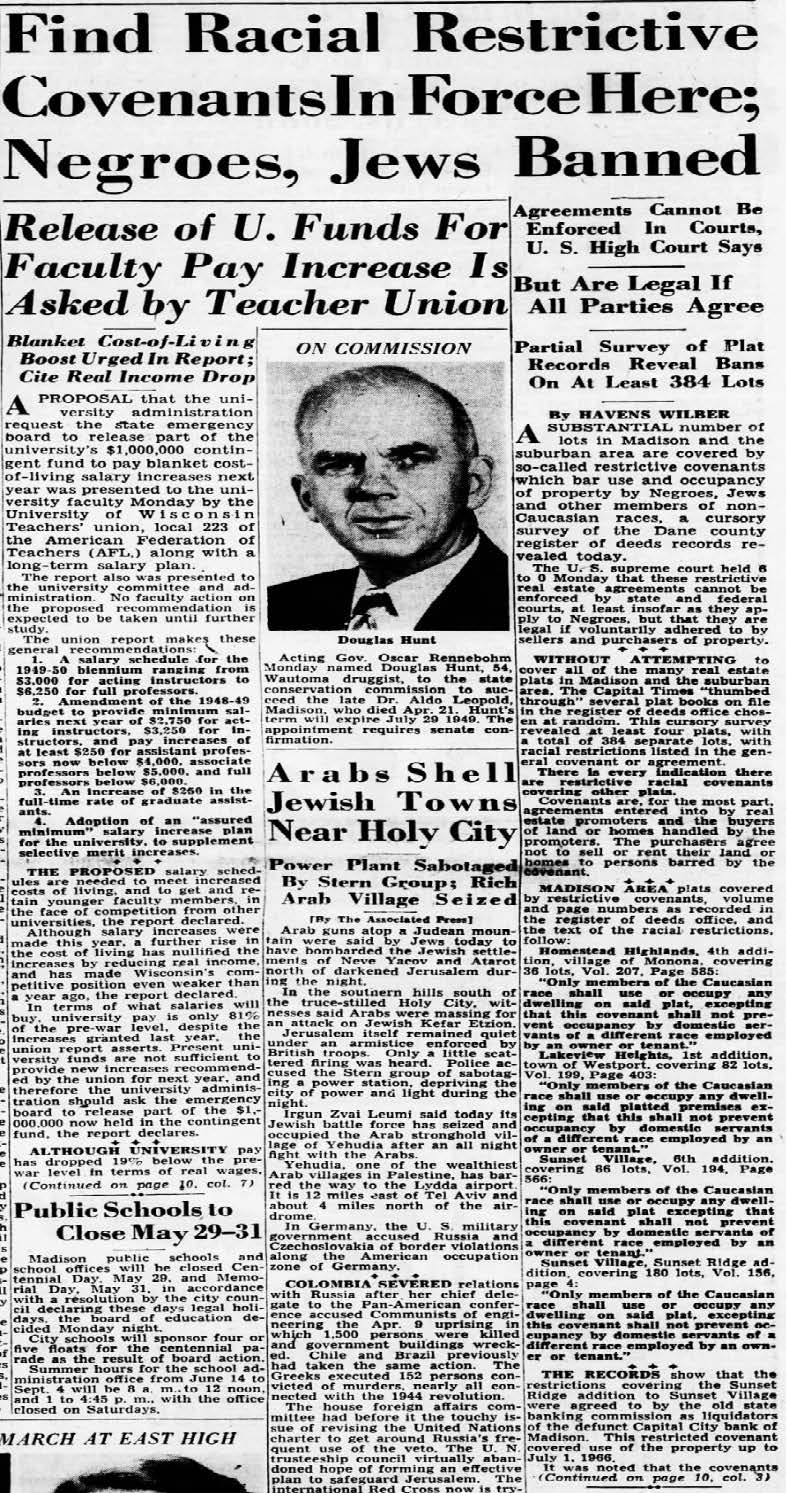
If you were to ask your average Madisonian to describe Madison in a few words, you would be likely to hear “tolerant” or “welcoming” pretty quickly. While Madison has a progressive reputation now, the dark history of legal discrimination still lingers in the deeds of many home owners.
In 1911, Roald Amundsen became the first person to reach the South Pole, the Chevrolet Motor Car Company was founded, and the first restrictive racial covenants began appearing in Madison. The first racial covenant was a restriction of a commercial building, 23 North Pinckney Street. The lease stated that the building could only have “responsible white tenants”.
Soon after, residential racial covenants started appearing. The west-side suburbs were the first to follow suit, with Nakoma being the most prominent example. Driven by a combination of rapid expansion and more well organized marketing by developers. The neighborhoods were sold as “protected” and “homogeneous” areas safe from the threatening presence of people of color.
The practice reached its zenith after 1934, when the Federal Housing Administration was formed. The FHA’s underwriting manual specifically states that “If a neighborhood is to retain stability, it is necessary that properties shall continue to be occupied by the same social and racial classes.” This essentially meant that in order for buyers to qualify for low interest FHA loans, many times properties had to have racial covenants.
In 1948, the Supreme Court ruled in Shelley VS. Kraemer that courts could no longer enforce racial covenants. While that was the legal end of the practice, it persisted throughout the 1950’s and into the 60’s as gentleman’s agreements. In 1963, Madison passed one of the first Fair Housing Ordinances in the country, making it illegal to discriminate in the sale or rental of housing. In 1968 the Federal Fair Housing act finally made discriminatory housing laws federally illegal ending the state-sanctioned era of housing discrimination.
While the legal enforcement of these covenants ended decades ago, the physical documents remain in the chain of title for thousands of Madison homes. If you want to see if your own home carries this "black mark," there are a few ways you can find out. The easiest place to start is the "Prejudice in Places" interactive map, a project created by the Dane County Register of Deeds and the Dane County Historical Society. This project has painstakingly documented over a thousand "unjust deeds" across the county, allowing you to search your specific address to see if it was once part of a restricted subdivision like Nakoma or Shorewood Hills.
If your home doesn’t appear on the map, you can look through your own paperwork. When you bought your home, you likely received a Title Abstract or a Title Insurance Policy. If you scan the "Exceptions" or "Covenants" sections for documents dated between 1911 and 1950, you may find the unpleasant legacy of racism residing in your own documents.
Finding this on your deed can be a sobering reminder that our "progressive" city was built on a foundation of exclusion. However, Wisconsin law now allows homeowners to file a Restrictive Covenant Modification. This doesn’t erase the historical record but it allows you to formally and legally renounce the language and change the public record to reflect the current inclusive values that we all drive for Madison to be. If you would like assistance in finding out if your home has a Racial Covenant, reach out and I’ll be more than happy to help.
-By Akeem Harper